
Julia Child was born on August 15, 1912, in Pasadena, California, and died on August 13, 2004, two days before her 92nd birthday. She was an author, television personality, and the woman who taught millions of Americans to cook French food at home. Her cookbook Mastering the Art of French Cooking (1961) and her PBS show The French Chef (1963–1973) changed how an entire country thought about food.
I bought my copy of Mastering the Art of French Cooking at seventeen, after watching Julia fail a potato pancake flip on late-night TV and laugh about it. That book has a cracked spine and butter stains on page 315. She wasn’t just a chef to me. She was permission to try something difficult, fail, and try again.
Who Was Julia Child?
Julia Child was born August 15, 1912, and died August 13, 2004. Two days shy of her 92nd birthday. In between, she became one of the most influential figures in American food history.
She was a chef, yes. An author. A television personality. But none of those words quite capture what she actually did.
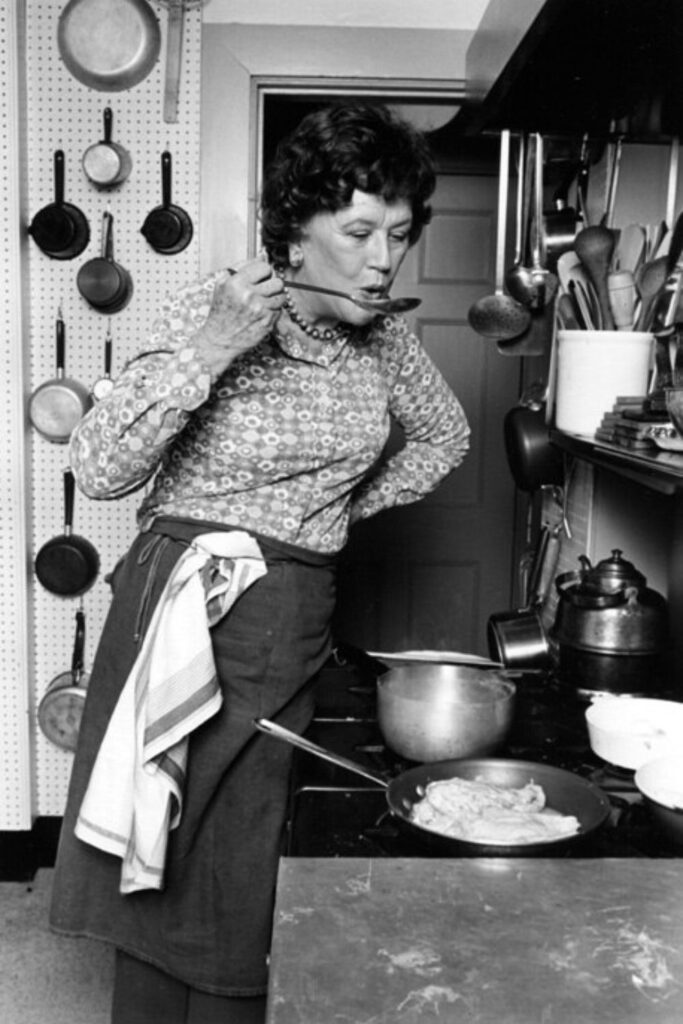
She showed millions of us that a cheese soufflé wasn’t as terrifying as it sounded. That a proper French omelette was within reach. That cooking could be joyful. Messy and imperfect and absolutely worth it.
Her cookbook Mastering the Art of French Cooking, published in 1961, became a sensation. Her PBS show The French Chef, which premiered in 1963 and ran for a decade, brought her into living rooms across the country.
And then there was her. Six feet two inches tall, with that unforgettable warbling voice and an attitude that said, essentially: mistakes happen, keep cooking.
Where Did Julia Child Grow Up?
Julia Carolyn McWilliams was born in Pasadena, California. Her father was a banker. Her mother came from money. The Weston family, who owned a paper company in Massachusetts.
Here’s the thing that surprises most people: Julia had absolutely no interest in cooking when she was young.
None.
At the Katharine Branson School for Girls in Northern California, she was the athlete. Tennis. Swimming. Basketball. At six feet two inches, even as a teenager, she was the obvious choice to captain the basketball team. She also led a hiking club called the Vagabonds, which tells you something about her personality. She was restless. Curious. Always moving.
After graduating from Smith College in 1934 with a degree in history, she drifted. Moved to New York. Tried advertising. Worked at a home furnishings store. Got fired, actually.
By her late twenties, Julia had no idea what she wanted to do with her life. She certainly had no idea she’d become a chef. She didn’t even learn to cook until she was 37.
I think about that sometimes. If you’ve ever felt like you found your calling late, like maybe you missed some window, Julia Child is proof that there’s no such thing.
How Tall Was Julia Child?
Julia stood six feet two inches tall (188 cm).
That’s tall now. In the 1940s and 50s, for a woman, it was remarkably tall.
Her height shaped her life in ways you might not expect. When World War II began and she wanted to serve, she applied to join WAVES and the Women’s Army Corps. They rejected her. Too tall. The military literally wouldn’t take her because she exceeded their height requirements.
On television, decades later, her height became part of her presence. She towered over everything. Her Cambridge kitchen, the one that’s now in the Smithsonian, had counters that were custom-raised to accommodate her frame. When the museum took the kitchen, they took those raised counters exactly as they were.
Her husband Paul was six feet one inch. They made a striking pair, both unusually tall for their time. Paul was ten years older than Julia, but they fit.
Her younger sister Dorothy was even taller at six feet four inches. Height ran in the McWilliams family.

How Did Julia Child Meet Her Husband?
Julia met Paul Cushing Child during World War II, in Ceylon. What’s now Sri Lanka. Both were working for the Office of Strategic Services, the OSS, which was the precursor to the CIA.
(Yes, Julia Child worked for an intelligence agency. I’ll get to that.)
Paul was a diplomat. An artist. Cultured in a way Julia wasn’t yet. He introduced her to good food, to wine, to the idea that eating well was a kind of art.
They married on September 1, 1946.
When Paul was posted to Paris in 1948, Julia went with him. That’s where everything changed. It was in France that Julia discovered cooking. Really discovered it, in a way that would consume the rest of her life.
Paul supported her completely. He photographed dishes for her cookbooks. He encouraged her when she decided to enroll at Le Cordon Bleu. Their partnership lasted nearly fifty years, until Paul died on May 12, 1994.
Julia kept working for another decade after that. But by all accounts, she never stopped missing him.
Did Julia Child Have Children?
No. She and Paul tried, but they couldn’t have children.
Julia spoke about this openly in later years. With acceptance, mostly. Some regret.
She became an “auntie” to many. Particularly close to her grandnephew Alex Prud’homme, who helped her write her autobiography, My Life in France, published posthumously in 2006.
In a way, her real children were the millions of home cooks she inspired. Everyone who ever attempted a French omelette because Julia made it look possible.
Was Julia Child a Spy?
Before the cookbooks and TV shows, Julia worked for the Office of Strategic Services during World War II. The OSS was America’s first centralized intelligence agency. The organization that would eventually become the CIA.
Was she a spy? Not exactly. She wasn’t running covert operations. She worked as a research assistant, later as a clerk. Eventually she ran the OSS Registry, managing classified documents.
But here’s the remarkable part: Julia was on a research team that developed shark repellent.
This sounds made up. It’s not.
During the war, shark attacks on downed pilots were a genuine problem. More critically, sharks kept setting off underwater explosives intended for German U-boats. The OSS put together a team to find a solution, and Julia helped test hundreds of chemical compounds until they developed something that worked. A “shark cake” that smelled like dead shark and could be attached to life vests.
That repellent became standard Navy issue. It was used into the 1970s.
Julia’s comment about her OSS years? “I must say we had lots of fun.”
Learn more about Julia’s secret WWII service →

What Did Julia Child Do Before Cooking?
Before any of this, before Paris, before Paul, before the OSS, Julia McWilliams was just a young woman who had no idea what she wanted.
In school she was the athlete, not the scholar. Outgoing. Popular. A little mischievous. At Smith, she joined a club called the Grass Cops, whose mission was keeping students off the campus lawns. That’s the kind of energy we’re dealing with.
After college, she drifted. Advertising. Odd jobs. Nothing that felt right.
It wasn’t until she was 36, sitting in a restaurant in Rouen, France, that everything clicked.
She ordered sole meunière. Fish, cooked simply in butter.
She described the experience as an “epiphany.” That single dish convinced her that French cooking was what she wanted to spend her life doing.
She enrolled at Le Cordon Bleu in 1949. She was the only woman in her class. She met Simone Beck and Louisette Bertholle, and together they founded a cooking school called L’École des Trois Gourmandes. The School of the Three Gourmands.
For nearly a decade, the three of them worked on what would become Mastering the Art of French Cooking.
Read the full story of how Julia Child became a chef.
What Is Julia Child Famous For?
The Cookbook
Mastering the Art of French Cooking was published in 1961. Julia was 49 years old.
The book took nearly ten years to write. One publisher rejected the manuscript for being “too long.” But when it finally came out, it became a sensation.
This wasn’t a book of simplified “French-ish” recipes for American kitchens. It was the real thing. Detailed, precise, uncompromising. And somehow, completely accessible.
I own a copy that’s falling apart. The pages are stiff with butter. That’s what a real cookbook should look like. Explore all 18 Julia Child cookbooks →
The French Chef
In 1963, Julia premiered The French Chef on WGBH, Boston’s public television station. The show ran for 206 episodes over ten seasons.
What made it revolutionary? Julia was real. She dropped things. Made mistakes. Asked for a bigger pan mid-episode, shrugged, and kept cooking.
She ended every episode with “Bon appétit!” Two words that became synonymous with her.
More shows followed: Julia Child & Company, Dinner at Julia’s, Baking with Julia, and Julia & Jacques Cooking at Home with her close friend Jacques Pépin.
Awards
Julia received nearly every major award in her field:
- Peabody Award (1964)
- Emmy Award (1966)
- National Book Award (1980)
- French Legion of Honor (2000)
- Presidential Medal of Freedom (2003)
Is Julia Child Still Alive?
No. Julia Child passed away on August 13, 2004, two days before her 92nd birthday. The cause was kidney failure. She died in Montecito, California, near Santa Barbara.
What Was Julia Child’s Cause of Death?
Julia died of kidney failure on August 13, 2004, in Montecito, California. She was two days short of her 92nd birthday. She had been in declining health in her final years but continued working well into her eighties.
Where Is Julia Child’s Kitchen Now?
In 2001, Julia donated her Cambridge, Massachusetts kitchen to the Smithsonian National Museum of American History in Washington, D.C.
The entire kitchen was transported. The pegboard with copper pots, the raised counters, the stove, over 1,200 utensils. Everything.
If you’re ever in Washington, go see it. Stand in front of that pegboard. You’ll understand why so many people fell in love with cooking because of her.
What Is Julia Child’s Legacy?
Julia established the Julia Child Foundation for Gastronomy and Culinary Arts in 1995. It still supports culinary education today.
In 2009, the film Julie & Julia starred Meryl Streep as Julia. It was an Oscar-nominated performance and introduced Julia to an entirely new generation.
In 2014, the U.S. Postal Service put her on a stamp. There’s even a rose named after her.
What Was Julia Child’s Net Worth?
When Julia died in 2004, her estate was estimated at around $38 million. Roughly $63 million adjusted for today.
That wealth came from decades of cookbook sales, television appearances, and speaking engagements. After Paul’s death in 1994, her estate was managed through a trust.
The Julia Child Foundation still holds the rights to her intellectual property. It continues to receive royalties from her books and uses the money to support culinary education.
Frequently Asked Questions About Julia Child
No. Julia and Paul Child tried to have children but were unable to. Julia spoke about this openly in later years. She became especially close to her grandnephew Alex Prud’homme, who co-wrote her autobiography My Life in France, published in 2006.
Julia worked for the Office of Strategic Services (OSS) during World War II, the agency that became the CIA. She wasn’t a field agent. She managed classified documents and helped develop shark repellent for the Navy. Her own description: “I must say we had lots of fun.”
Julia stood 6 feet 2 inches (188 cm). Her height was so unusual for the era that the military rejected her application to WAVES and the Women’s Army Corps because she was too tall. Her Cambridge kitchen, now at the Smithsonian, had custom-raised counters to accommodate her frame.
When Julia died in 2004, her estate was estimated at approximately $38 million (roughly $63 million adjusted for inflation today). Her wealth came from cookbook royalties, television, and speaking engagements. The Julia Child Foundation still manages her intellectual property.
Paul Child worked for the OSS alongside Julia, but as a visual presentation specialist and mapmaker, not as a spy. He designed war rooms and created visual displays for intelligence briefings. After the war, he worked as a diplomat with the U.S. Foreign Service, the posting that took them to Paris in 1948.
Julia was 36 when she had her famous sole meunière in Rouen, France, the meal that changed her life. She enrolled at Le Cordon Bleu in 1949 at age 37. Before that, she had no culinary training and little interest in cooking.
Julia’s younger sister Dorothy McWilliams was 6 feet 4 inches tall, even taller than Julia. Height ran in the McWilliams family.
Quick Facts
| Fact | Details |
|---|---|
| Full Name | Julia Carolyn McWilliams Child |
| Born | August 15, 1912, Pasadena, California |
| Died | August 13, 2004, Montecito, California |
| Height | 6’2″ (188 cm) |
| Spouse | Paul Cushing Child (married 1946–1994) |
| Children | None |
| Education | Smith College (History, 1934) |
| Culinary Training | Le Cordon Bleu, Paris (1949) |
| Famous Book | Mastering the Art of French Cooking (1961) |
| Famous Show | The French Chef (1963–1973) |
| Signature Phrase | “Bon appétit!” |
| Net Worth (2004) | ~$38 million |
| Kitchen | Smithsonian National Museum of American History |
Start Cooking
Julia’s recipes weren’t meant to sit in a museum. They were meant to be cooked. Burned, sometimes. Attempted again.
If you’ve never tried one, you’re exactly who this site is for.
Bon appétit.
– Claire