 Claire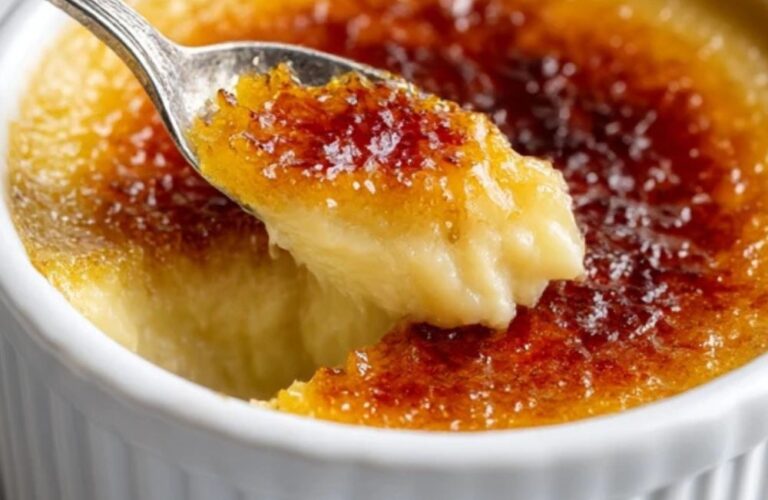
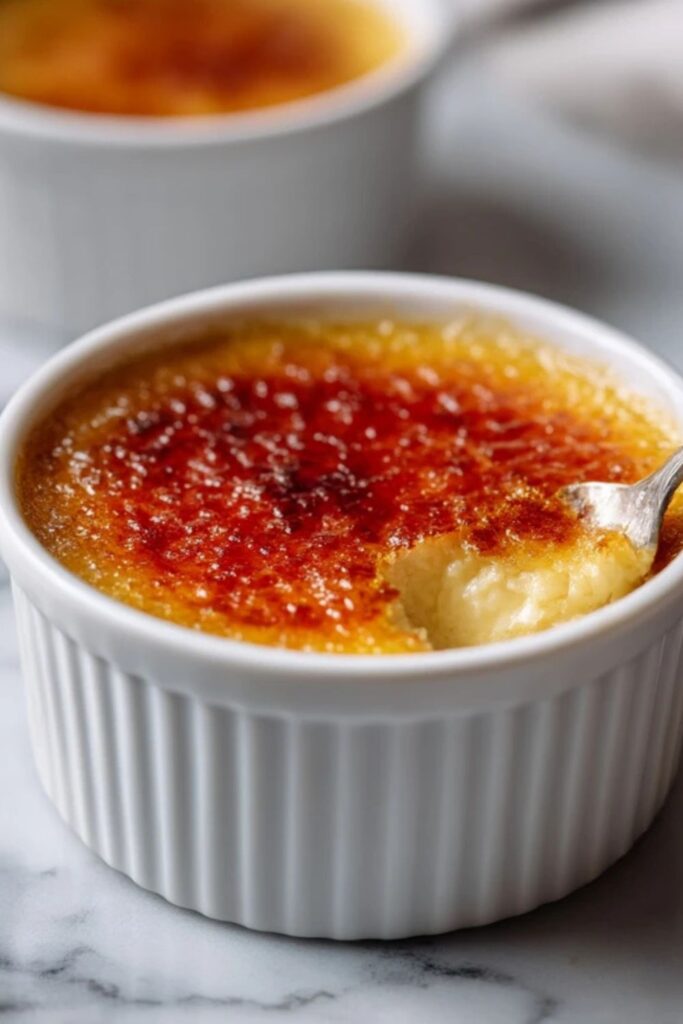
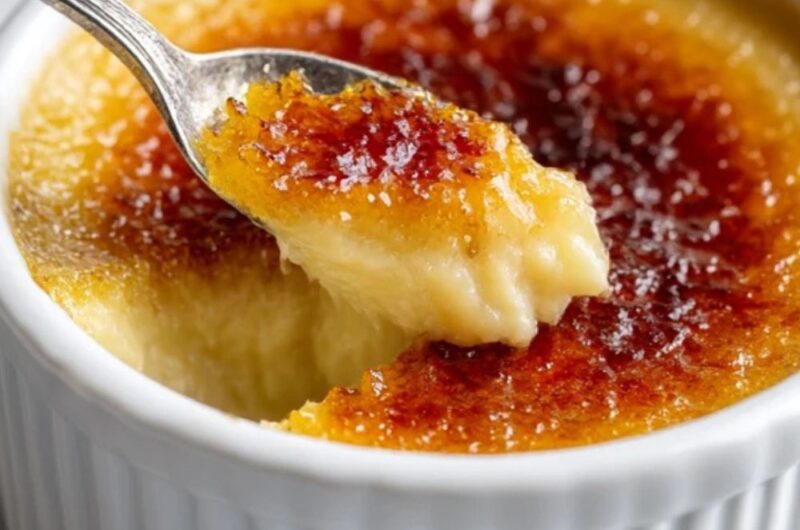
Crack through that glass-like caramel top with your spoon. Sink into cold, silky cream underneath. Julia Child Crème Brûlée is one of the most satisfying desserts ever invented, and here’s a surprise: it’s English, not French.
Julia notes on pages 589-590 of Mastering the Art of French Cooking that “Crème brûlée originated in England, it appears, at Christ’s College in Cambridge.” Her version is essentially a rich crème anglaise (custard sauce) made with cream instead of milk, chilled, and topped with caramelized sugar or pralin.
This is an easy crème brûlée recipe that doesn’t even require baking. You cook the custard on the stovetop, chill it, caramelize the top, and serve. Restaurant-quality results with simpler technique.
I make this when I want to impress without stress. The torch at the end is pure theater.
What is crème brûlée? A rich custard dessert topped with a layer of hard caramelized sugar. “Brûlée” means “burnt” in French, referring to the torched sugar crust.
Why You’ll Love This Recipe
- Easier than you think: Stovetop custard, no water bath, no oven.
- The crack is everything: That first tap of the spoon through caramel is pure satisfaction.
- England’s gift to dessert: Julia set the record straight on its origins.
- Make-ahead friendly: Custard can be prepared a day ahead.
- Impressive but simple: Six ingredients, maximum impact.
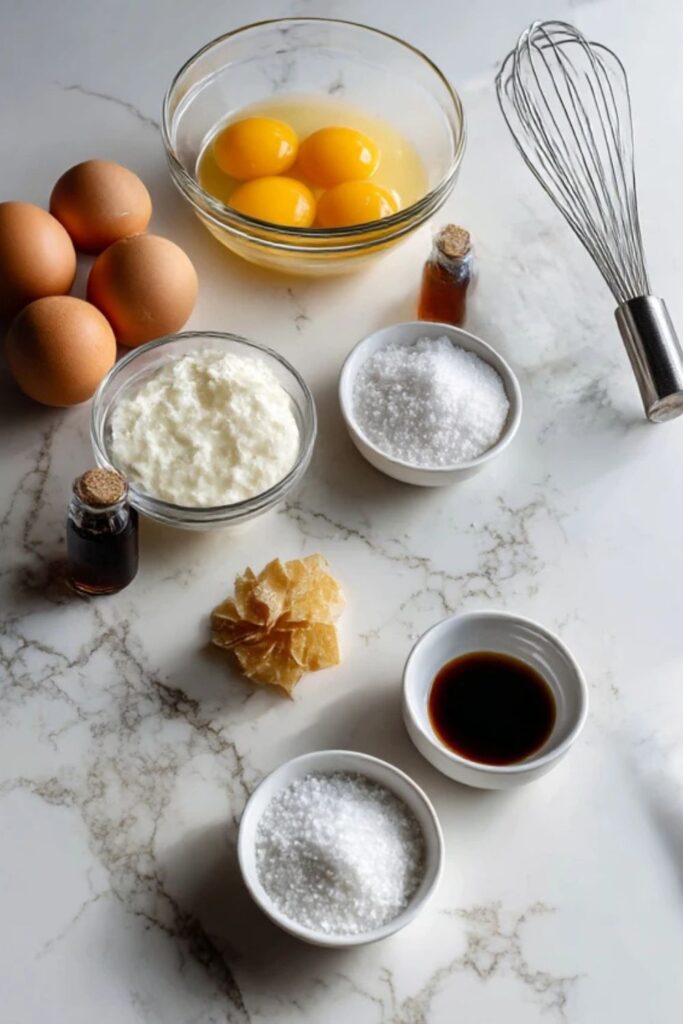
Julia Child Crème Brûlée Ingredients
From Mastering the Art of French Cooking, Vol. 1, Pages 589-590. Serves 6.
For the Custard:
- 4 egg yolks
- ⅓ cup sugar (half the normal crème anglaise amount)
- 1½ cups heavy whipping cream
- 1 Tb vanilla extract
For the Topping:
- Brown sugar or superfine sugar for caramelizing
- OR: ⅛-inch layer of pralin (Julia’s preference)
Equipment:
- Heavy-bottomed saucepan
- Wire whisk
- 6 ramekins or one shallow serving dish
- Kitchen torch or broiler
How To Make Julia Child Crème Brûlée
Step 1: Beat Yolks to the Ribbon
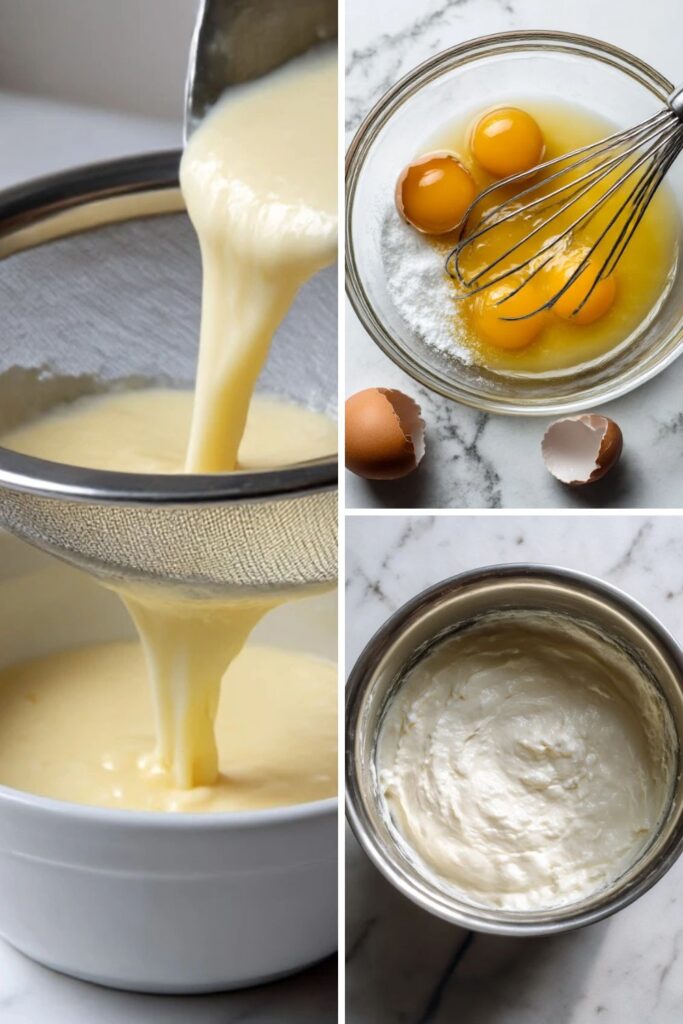
- Combine yolks and sugar: Beat until thick, pale yellow, and the mixture falls in a slowly dissolving ribbon.
Step 2: Heat the Cream
- Warm cream: Heat in saucepan until just simmering. Don’t boil.
- Temper the yolks: Beating constantly, add hot cream in a very thin stream of droplets. This prevents scrambling.
Step 3: Cook the Custard
- Return to heat: Pour mixture back into saucepan. Set over moderate heat.
- Stir constantly: With a wooden spoon, reaching all over the bottom.
- Cook until it coats the spoon: A light cream that holds on the back of the spoon. Do not let it simmer. If it approaches a boil, it will curdle.
- Remove immediately and add vanilla.
- Strain if needed: Pass through a fine sieve if any lumps formed.
Step 4: Chill
- Pour into ramekins or serving dish.
- Refrigerate at least 2 hours: Until thoroughly cold. Can be overnight.
Step 5: Caramelize the Top
- Sprinkle sugar evenly: About 1 Tb per ramekin. Spread thin and even.
- Torch or broil: Pass torch flame slowly across sugar until it melts, bubbles, and turns amber. Or place under broiler, watching carefully.
- Let sugar harden: 1-2 minutes.
- Serve immediately. The top stays crisp for about 30 minutes.
Recipe Tips
- Do not let custard simmer: This is the only rule that matters. Keep it under a simmer or yolks scramble.
- Thin stream when tempering: Add cream in droplets first, then thin stream. Rushing this curdles eggs.
- Half sugar in custard: Because the caramelized top adds sweetness.
- Cream, not milk: This is what makes it richer than regular crème anglaise.
- Even sugar layer: Uneven thickness means uneven caramelization.
- Torch is easier than broiler: More control. Worth buying one.
Pralin Alternative
Julia’s preferred topping:
Pralin is caramelized almonds ground to a powder. Spread ⅛-inch layer over cold custard instead of torching sugar. This creates “crème anglaise pralinée.”
To make pralin:
- Cook ½ cup sugar with ¼ cup water until amber caramel.
- Stir in ½ cup sliced almonds.
- Pour onto oiled baking sheet, cool completely.
- Pulverize in food processor.
Store airtight. Use on ice cream too.
Stovetop vs. Baked Method
Julia’s version is stovetop. Most modern recipes bake in a water bath.
| Stovetop (Julia’s) | Baked |
|---|---|
| Faster, no oven | Longer, bakes 45 min |
| Stir constantly | Hands-off |
| Thinner, saucier texture | Thicker, firmer set |
| Can burn if not careful | More forgiving |
Both are valid. Julia’s is simpler if you pay attention.
How To Store
Custard (before topping): Covered, refrigerated, up to 2 days.
After caramelizing: Serve within 30 minutes. Sugar softens in humidity.
Cannot be frozen: Texture breaks down.
Nutrition Facts
Per serving (1/6 of recipe):
- Calories: 290 kcal
- Protein: 4g
- Total Fat: 22g
- Saturated Fat: 13g
- Carbohydrates: 20g
- Fiber: 0g
- Sugar: 19g
- Sodium: 30mg
- Cholesterol: 200mg
FAQs
It got too hot. Keep below a simmer. If it curdles, strain immediately and it may still be usable.
No. Broiler works. But a torch gives more control and is more fun.
Humidity or waited too long. Serve immediately after caramelizing.
You’ll have crème anglaise, not brûlée. It won’t be as rich.
Julia says so. Christ’s College, Cambridge claims to have invented it in the 1600s.
Julia Child Crème Brûlée Recipe
Course: DessertCuisine: FrenchDifficulty: Easy6
servings20
minutes10
minutes290
kcalThis is the classic Julia Child Crème Brûlée recipe. Unlike baked versions, this recipe uses a stovetop custard technique to create an incredibly silky texture. It is chilled and then finished with a brittle, caramelized sugar topping.
Ingredients
- For the Custard:
4 egg yolks
⅓ cup sugar (half the normal crème anglaise amount)
1½ cups heavy whipping cream
1 Tb vanilla extract
- For the Topping:
Brown sugar or superfine sugar for caramelizing
OR: ⅛-inch layer of pralin (Julia’s preference)
- Equipment:
Heavy-bottomed saucepan
Wire whisk
6 ramekins or one shallow serving dish
Kitchen torch or broiler
Directions
- Step 1: Beat Yolks to the Ribbon
- Combine yolks and sugar: Beat until thick, pale yellow, and the mixture falls in a slowly dissolving ribbon.
- Step 2: Heat the Cream
- Warm cream: Heat in saucepan until just simmering. Don’t boil.
- Temper the yolks: Beating constantly, add hot cream in a very thin stream of droplets. This prevents scrambling.
- Step 3: Cook the Custard
- Return to heat: Pour mixture back into saucepan. Set over moderate heat.
- Stir constantly: With a wooden spoon, reaching all over the bottom.
- Cook until it coats the spoon: A light cream that holds on the back of the spoon. Do not let it simmer. If it approaches a boil, it will curdle.
- Remove immediately and add vanilla.
- Strain if needed: Pass through a fine sieve if any lumps formed.
- Step 4: Chill
- Pour into ramekins or serving dish.
- Refrigerate at least 2 hours: Until thoroughly cold. Can be overnight.
- Step 5: Caramelize the Top
- Sprinkle sugar evenly: About 1 Tb per ramekin. Spread thin and even.
- Torch or broil: Pass torch flame slowly across sugar until it melts, bubbles, and turns amber. Or place under broiler, watching carefully.
- Let sugar harden: 1-2 minutes.
- Serve immediately. The top stays crisp for about 30 minutes.
Notes
- Do not let custard simmer: This is the only rule that matters. Keep it under a simmer or yolks scramble.
- Thin stream when tempering: Add cream in droplets first, then thin stream. Rushing this curdles eggs.
- Half sugar in custard: Because the caramelized top adds sweetness.
- Cream, not milk: This is what makes it richer than regular crème anglaise.
- Even sugar layer: Uneven thickness means uneven caramelization.
- Torch is easier than broiler: More control. Worth buying one.
Source: Mastering the Art of French Cooking, Vol. 1 by Julia Child, Pages 589-590
– Claire